


Week ended Sept 18, 2026: central banks deliver as expected

Global equity markets were mixed this past week, with Japanese stocks leading gains and most U.S. and European indices registering modest losses. Tech stocks were back in vogue in the U.S., which drove WoW gains in the NASDAQ even as other benchmark U.S. stock indices lost ground.
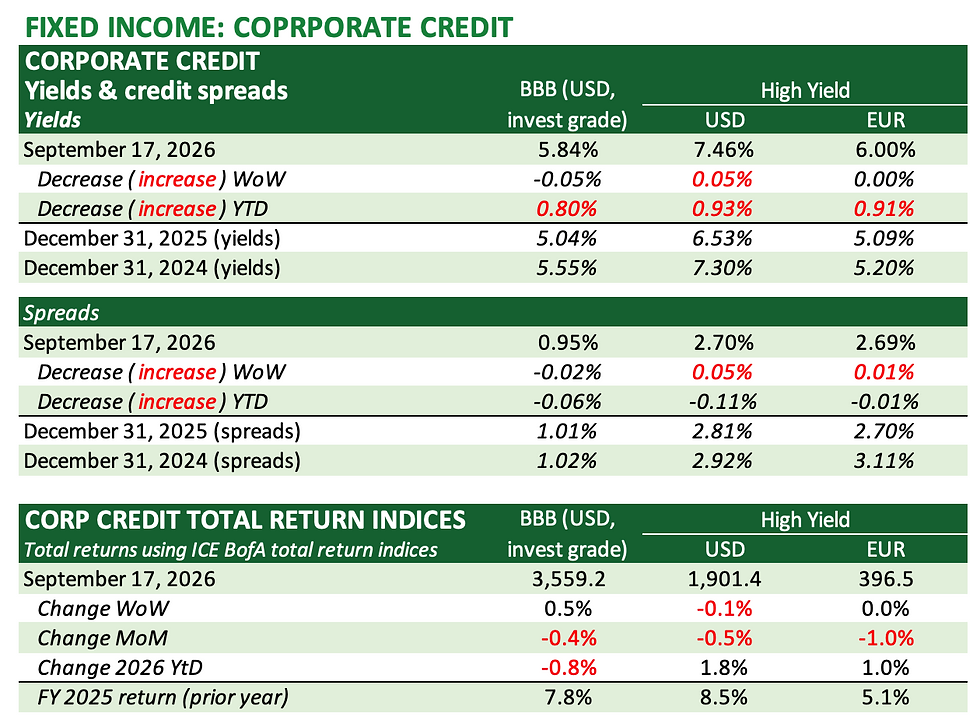
Global bond yields – including yields in the U.S. Treasury bond market – were also volatile. Bond investors found some relief though after central banks delivered largely along the lines expected, ramping up their efforts to address above-target inflation. 10y yields in the U.K. and the Eurozone were better last week, while 10y yields in Japan were volatile but about flat. U.S. Treasuries lost ground as yields headed higher across the curve, with the sell-off accelerating into the afternoon session on Friday. It is interesting to note that the 10yr-2yr UST yield curve has been flattening quickly over the last month or so.
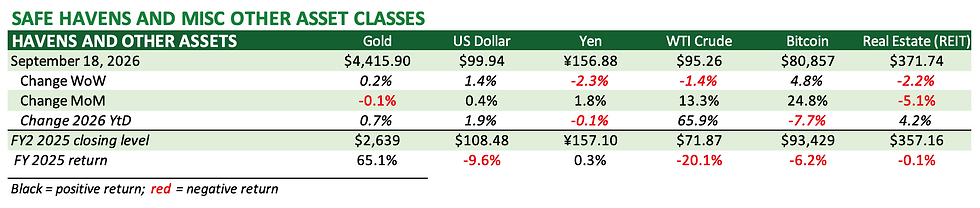
Oil prices remain elevated, the Japanese Yen slipped from its recent highs, and Bitcoin gained ground in a volatile week even after the Trump-sponsored Clarity Act which was before the Senate was defeated last Tuesday (covered in “The American Prospect” which is not behind paywall).
The table below summarises the performance of major indices and assets that I track, with more detailed tables at the end of this update.

KEY DRIVER: CENTRAL BANK DECISIONS
The three major central banks did exactly as expected last week, which I introduced in a mid-week post here.
The graph below (A.I.-generated) shows the trajectory of policy rates since the beginning of 2020, and expectations for the fourth quarter of 2026. Note that further tightening is expected before year-end in the U.S., the U.K. and the Eurozone.

U.S. / Fed: Investors were mostly focused on the decision of the Fed, less because it was fairly straight-forward and more because of the message the decision would send about Fed independence, under pressure since Mr Trump returned to office. The FOMC voted unanimously to increase the Fed Funds rate by 25bps, and indicated that another 25bps might occur before year-end.
The headlines following the FOMC decision stabilised bond markets and initially gave a boost to stocks, mainly because it addressed the elephant in the room – would Trump-sponsored Fed Chair Warsh do the right thing as Fed chair and address elevated inflation, or would he kowtow to the president who is suggesting that U.S. interest rates should be much lower?
Fortunately for investors, Mr Warsh took the high ground.
The FOMC decision is here, and the revised Summary of Economic Projections is here.
Fed Chair Warsh did not join his fellow-FOMC members in providing a dot in the infamous “Dot Plot” (in the Economic Projections), and the press conference following the decision was only half its normal time. One thing is certain so far during Mr Warsh’s short tenure: he is clearly sticking to his mantra of “less is better.”
Japan / BoJ: The Bank of Japan also fell in line by raising its overnight unsecured policy rate by 25bps to 1.25%, the highest in 31 years, although this decision was arguably more nuanced. The willingness to raise its borrowing rates is one of the key reasons that the Yen has strengthened as of late, even though the Yen has come off of its recent highs. The monetary policy decision was not straightforward in that there were two dissenting votes (of nine) on the committee. And not coincidentally, both dissenters are considered doves appointed by current PM Takaichi. BoJ governor Ueda was not entirely convincing in comments regarding the path of further monetary policy tightening, which caused the Yen to weaken in spite of the 25bps increase in the policy rate. The press has accurately described this as “dovish tightening.”
And while I am on the topic, how about the staying power of FX intervention? See “Government intervention is not a long-term fix” for my two cents.
U.K. / BoE: In the U.K. the Bank of England did not increase its overnight Bank Rate, in line with expectations (BoE press release here). The BoE has – at least for now – taken a different path than the ECB, the Federal Reserve and the Bank of Japan.
Six members of the MPC voted to hold the Bank Rate at 3.75%, and three members voted to increase the rate by 25bps. The split is not surprising in that U.K. inflation is expected to top 4% in the coming months.
Like the Fed and the BoJ (and the ECB the week before), the BoE signalled that policy rate increases are ahead should high oil prices continue to fuel above-target inflation. The BoE did ease the pressure at the long end of the Gilt curve by stopping its sale of 20- and 30-year Gilts and instead opting to let near-maturity bonds run off instead.
It is the U.K. that still troubles me most because of its smaller and less-diversified economy (thanks BREXIT), and a government that has no choice but to navigate a tricky path as far as fiscal policy. The U.K. Autumn Budget will be presented to parliament by Chancellor John Healey on Wednesday, October 28th. That should be interesting.
MID-TERM ELECTIONS
The U.S. Congressional elections can’t arrive and go away fast enough for me. These are a distraction for investors globally, with most of the campaigns laden with inuendo and falsehoods that in many ways are a sad reflection of American politics at the moment.
The polls suggest that the Democrats might take one or both chambers of Congress, which – if it were to occur (and it appears likely) – could make the next two years in the U.S. even more chaotic than the last two years. And if there is chaos in the U.S., there will be chaos globally.
Six weeks is a long time in politics, so who knows for sure. As an investor, I consider this election cycle far from supportive of risk assets as the midterms approach. This is simply one more thing that concerns me, forcing me to be relatively defensive in my portfolio at this point of the cycle.
We shall get through it though – let’s have a kumbaya moment quickly to soothe our shattered nerves.
WHAT’S AHEAD?
What will likely be most watched this coming week is a series of preliminary manufacturing and services PMI data for September which will be released for the U.S., the U.K. and the Eurozone. This will provide messages as to how the economy is doing in each bloc.
MARKET TABLES UPDATED


_________________
**** Follow E-MorningCoffee on BlueSky, and please like and comment on my posts right here on my blog. You need to be a subscriber, so please sign up. Thanks for your support. ****


Comments