


Week ended October 23, 2026: stocks stumble, bonds rally

I am trying a new format for the weekly update. Your comments are welcome. I find any and all feedback on my blog helpful.
I am also moving to Substack, so check out my site TimsTake here and subscribe.
Global stocks
Stocks started the week on the front foot, but faded mid-week. The culprit was a familiar tech headache: mounting concerns over the monetization timeline for massive AI capital investments. The slide quickly broadened, dragging down European and Asian indices in its wake.
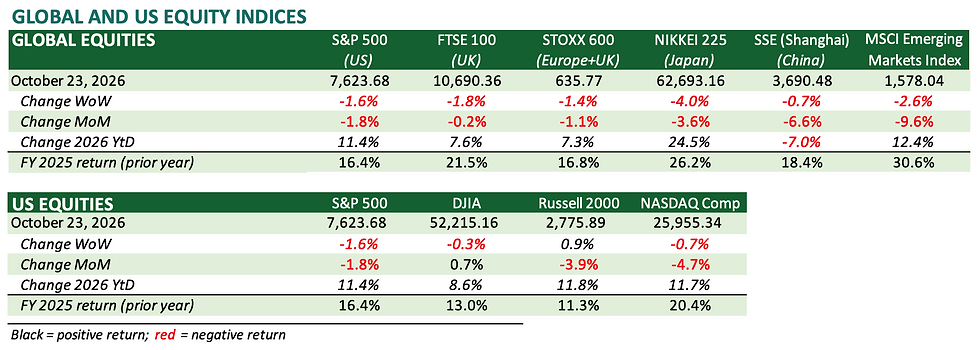
Drilling deeper into equities, the “boring stuff” again performed, helping indices that are light technology (like the DJIA and the Russell 2000) outperforming the NASDAQ and the S&P 500 for the week.
US Treasuries (and other government bonds)
US Treasuries rallied as a safe haven play, overwhelming ongoing concerns about elevated long-term inflation and growing debt / deficits. Yields were lower across the curve, with intermediate- and long-term bonds performing the best. Suddenly, locked-in duration looks tactical, though I remain cautious about extending risk out beyond the 2-year mark. While long-term Treasury total returns bounced into positive territory this week, their year-to-date performance remains firmly in the red.

In the global bond market, focus continues to be on French government bonds. The yield on the 10-year French government bond (the OAT) surged above 5% for the first time since 2002, peaking mid-week at 5.14% but closing the week slightly better albeit still above 5% (5.04%). The spread of the “gold standard” 10-year German government bond (the Bund) widened 30.5bps last week, reflecting both ongoing concerns about France and a flight-to-quality (which favoured German bonds).
Corporate bonds
Not surprisingly, credit spreads remain under pressure in both the investment grade and high yield markets. Investment grade spreads widened 5bps last week, and high yield spreads widened 9bps. A softening Treasury curve cushioned the blow, preventing deeper nominal damage across corporate credit. Even so, systemic cracks are appearing: investment-grade spreads have widened by 16 bps over the last month, while high-yield spreads have blown out by a steep 72 bps.

The deterioration is less to do with credit (so far), and more to do with supply. Companies across the credit spectrum cannot get capital fast enough for data centres, which could morph eventually into credit concerns. I thought the graphic below from Bloomberg Opinion writer John Authers shows very well what has happened to credit spreads in the A.I. infrastructure the last year.

Havens, currencies and other assets
Gold fell below $4,000/oz intraday on Friday although the precious metal managed to end the week just above this important support level (at $4,010/oz). The money that came out of stocks last week found its way into US Treasuries, but not into gold, unusual in that gold is generally considered a safe haven asset that receives inflows when market sentiment is risk-off. Gold also normally benefits from lower interest rates (since gold offers no current return), although the rally in Treasuries last week (meaning lower yields) did not spill over positively into gold. This unusual divergence probably reflects how fully valued the precious metal was in the early part of this year.
Oil prices were reasonably steady through much of the week, but gapped wider on Friday hitting a six-month high. The culprit is simply more of the same – ongoing geopolitical risk in the Gulf as the US-Iran situation remains unsolved and highly volatile.

The US Dollar index hovered near its recent floors. While the Euro and British Pound traded in tight ranges against the greenback, the Japanese Yen sharply outperformed as carry trades continued to unwind globally.
KEY DRIVERS LAST WEEK
New / ongoing concerns about capex spend for A.I. data centres. There is no doubt A.I. will come fast and furious, and will hopefully improve productivity. But the investment needed / capital required, and the timing of payback, is difficult to predict.
The earnings I was watching last week included NFLX, META and TSLA. NFLX was in line on the top line and beat on the bottom line, although the subscriber trends do not seem particularly favourable and the streaming service has lacked a recent “knock-out” hit. Both META and TSLA beat on top- and bottom-lines. META surged post-earnings, but due to capex spend concerns the stock gave it all back and more on Thursday and Friday, closing the week down nearly 10%. TSLA fared better, up 5% WoW. NFLX was down 7%.
As far as economic news, China reported 3Q26 GDP (4.5% YoY) in line with expectations. Global PMI data was a mixed bag. Eurozone PMI data suggested slower manufacturing and services growth (albeit not contractionary outside of France), and higher input prices. US PMI data was solid as far as both manufacturing and services, indicating much stronger growth than in Europe.
In the UK, PMI was better than expected, which is the good news. However, the bad news is that September inflation came in hotter than expected, which increased the odds that the Bank of England will raise its policy rate at its upcoming monetary meeting.
WHAT'S AHEAD THAT MATTERS
Central bank meetings: The FOMC, ECB and Bank of Japan all have monetary policy meetings this coming week, and all are expected to hold. The Bank of England meets the following week, and is expected to increase the Bank Rate by 25bps.
170 or so S&P 500 companies release earnings this coming week, including Mag 7 companies AAPL, MSFT, GOOG and AMZN. As far as semi-conductor companies, investors will be focused on AMD this week. The week also includes earnings from global payment giants V and MA, oil giant XOM, and pharmaceutical company LLY.
Several countries report 3Q26 GDP data next week. Home sales and durable goods data will be released just before the FOMC meeting, and PCE data will be released after. CPI will also be released in Japan.
The situation in the Gulf remains far from resolved, with the US and Israel threatening further attacks on Iran after the US mid-term elections. This is keeping pressure on global oil prices, with no relief in sight.
The US midterm elections are November 3rd, with all 435 seats up for election in the House of Representatives, and 33 of 100 seats up for election in the Senate. The rhetoric coming from both Republicans and Democrats would be funny were it not laced with so many mistruths and so much innuendo, both of which are sad to hear. The sooner the midterms come and go, the better.





Comments